
I landed at JFK a mere two hours before the start of the evening event at the Pace Gallery in Chelsea. From airport to hotel, hotel to gallery, it was less about taking time and more about finding it.
For a one-night-only event called The Gift of Time, Seiko Group Corporation built the space around ma, the Japanese concept of the interval between moments. Shinji Hattori, Seiko Group's chairman and Group CEO, welcomed guests by video and explained the choice: "For such a fast-paced, high-energy city, we thought hard about what 'The Gift of Time' could mean. And decided that the best 'gift' for this city would be the gift of MA(間). In Japanese, 間 means a sense of space, an opening, an emptiness, and much more."

Photo: Seiko
On the gallery's sixth-floor terrace, Souyuu Yamazaki of the Urasenke school led tea ceremonies in a Tea House designed by Kengo Kuma. Wood chips, traditional tatami mats, and ceremonial matcha – the true, slightly bitter, served with a bite of something sweet – filled the breezy outdoor space. Up a few floors, the exhibition showed the first Grand Seiko, the Grand Seiko Kodo constant-force tourbillon, the Credor Locomotive and the Credor Eichi II, along with Kuma's architectural model of Grand Seiko Studio Shizukuishi. Although it was a single-night event, Credor's pop-up at the Grand Seiko Flagship Boutique New York, at 540 Madison Avenue, runs through November 2, with the Locomotive and pieces from the Goldfeather and Eichi II collections.

Photo: Seiko
Hiromi Kanagawa, Senior Executive Vice President of Seiko Group Corporation, hosted. She took the title in June, in her 41st year at Seiko. She wore a Grand Seiko Evolution 9 Collection watch, her current personal favorite that is also favored by her husband, who often borrows it. We started talking before she gave her remarks and finished afterward, with the help of interpreter Ayami Nakao.
Crown & Caliber: Belated congratulations on your new role. Although you have been with the company over four decades, this is a new position. What is the top priority you'd like to accomplish in your first year as senior executive vice president?
Kanagawa: This year is going to be my 41st year at Seiko. So that is like a very long time to be in one company. I'm a little bit shy to say this, to admit this, but I myself am a great fan of Seiko as a company. And I love Seiko fans. My position is overseeing corporate communications, so I feel very blessed to have this role because it is really about conveying my love for Seiko and growing more fans. So to your question, the one thing I want to do, not just this year, but what I'm really thinking about is I really want to nurture more fans, and give them a deeper love for Seiko.

Photo: Seiko
C&C: How do you nurture the fans who already exist, while adding new fans, not only to Seiko but to Grand Seiko and Credor too?
HK: I think the word fan is very important for me because when I'm saying I want to nurture fans or bring in more fans, it's not about awareness levels, it's not about gaining awareness or visibility. To make sure that we're nurturing fans is about sharing stories and having an empathetic point of view and really being able to build a bond, a genuine connection, and this is what I'm interested in.
C&C: That explains tonight in many ways. But tell me, how are you trying to build that bond?
HK: One way is storytelling, but the storytelling is important in a way that it's not commercial. So this Gift of Time, the event that we're doing today, it's not about a product launch. But rather, it's very much about the philosophies, the spiritualities behind the brand and what we believe in as a brand. That kind of storytelling is very important for the brand and where we're going.
C&C: Many companies, both within the world of watches and outside of it, are leaning on emotion and storytelling to cultivate a new crop of fans and clients. Car brands are doing this. Spirits brands are doing this. How are you managing to tell your story authentically?
HK: When Seiko first became known to the world, it was in the 1960s with the Tokyo Olympics. And I think the differentiation, our point of difference, is that when we talk about storytelling, it's not about us. So with the Tokyo Olympics, we were obsessed that we had an accountability to the precision of the athlete's time, that we had a responsibility to be precise because it's the athlete's life on the line. So when we're telling stories, it's not only about our stories and really about our responsibility, our accountability of making sure that we stand for people's time. Athletes are spending their entire life to be able to be measured, and so our responsibility is that we are accurate to like 1,000th of a second. That's our accountability. That type of storytelling isn't about our products, it's about our precision. It's more about accountability, the weight that we carry that enriches people's time.
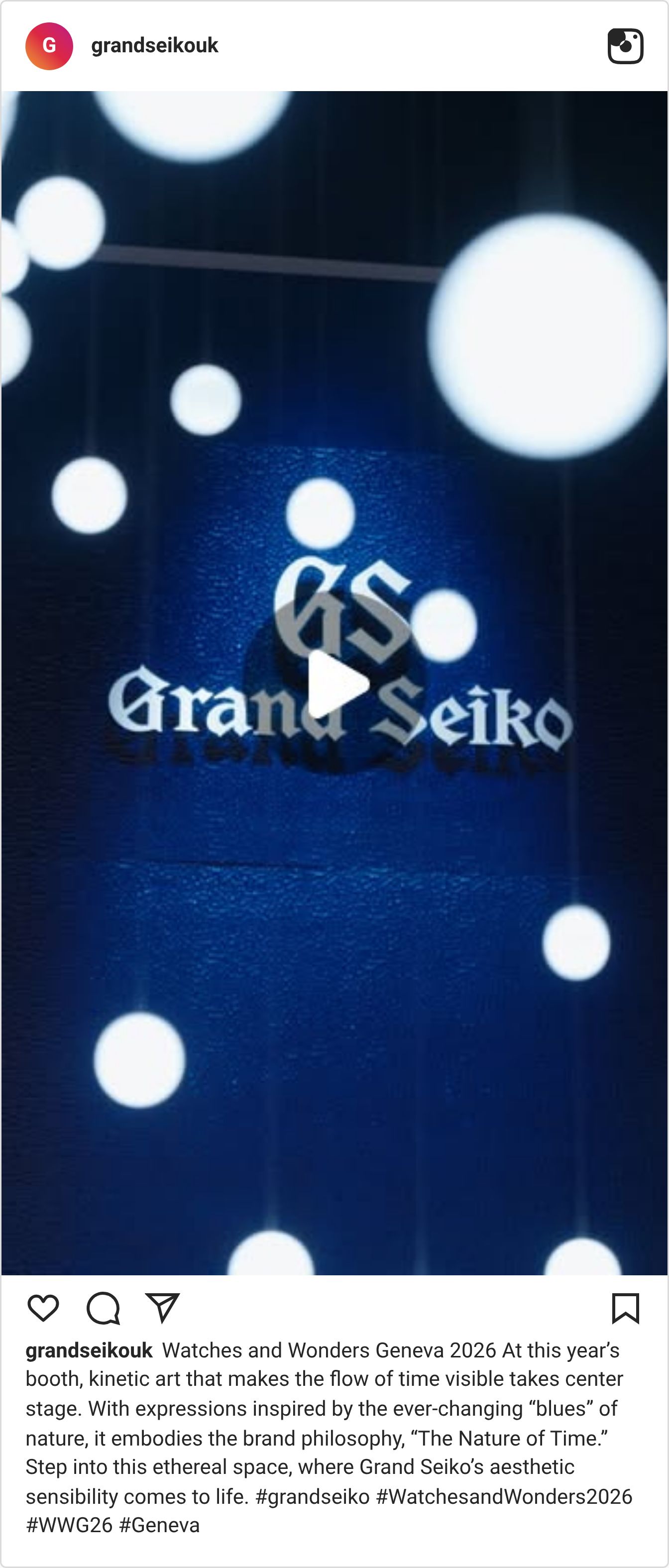
C&C: At Watches and Wonders this year, your booth celebrated nature, craftsmanship and a deep attention to detail, which to me feels very Japanese. How do you differentiate that craftsmanship and style in a market that is so Swiss-dominant?
HK: I think the differentiation is about empathy, so it's not about us designing something because we think something is beautiful, but it's more about from a perspective that it's durable, or the fact that the readability is very present, so that the design doesn't get in the way. We're very much about the fact that when you look at a Seiko watch, the viewer has great pride in the readability, and we don't add any egoistical perspective of more designed or style or anything like that. Everything is very much about the essence.
The conversation paused for the evening's opening remarks and resumed afterward.
C&C: Act immediately, follow through without fail, finish what you start. You were once quoted in an interview speaking about those three philosophies as your guiding ones. How do you apply those three actions to the priorities you described earlier, empathy and experience?
HK: So to the first part, act immediately: we're really going to accelerate globalization. So really, being much more intentional about being beyond Japan. Also, when you say global, there's many different markets, but to really be able to narrow it down, America is a very important market for us. We're prioritizing America. There's diversity here. There's an acceptance here. And being able to make fans here will influence other countries.
C&C: How so?
HK: We have a social initiative, which is called the Seiko [Summer] Jazz Camp. Seiko is always invested in the power of music, and this was [the camp's] 10th anniversary. It's kind of like a cultural exchange where there's Japanese budding young aspiring jazz musicians. We would invite American professional jazz players to Japan and to coach these aspiring musicians, which some of them then become professional. For [me], Jazz at Lincoln Center is one of the [great] places of jazz. So it was a dream for [me] to be able to do this, and that's what [we] did this year in July. So we did this 10-year anniversary, which was like the teachers of jazz that have always taught these students, and two alumni, Japanese students that actually became professional, so their jamming together was done at the Lincoln Center Dizzy's Club this year. And we invited all our retail partners so that they could enjoy everything that we've been able to build over the years, because this took 10 years to build. So these kinds of cultural events, not necessarily just through products, but these cultural events that help the globalization of Seiko in telling a different kind of storytelling. That's the act immediately.

Photo: Seiko
C&C: What was your very first Seiko watch? How did you get it, and do you still have it?
HK: It was a gift from my parents when I was 12 years old. I'm not making this up. It was a Seiko watch.
C&C: Which one?
HK: Which one? I don't remember, but it was a brown dial quartz watch.
C&C: What was the first watch you got after you joined the company?
HK: So in Japan, when you get married, you exchange gifts. The first Seiko watch I bought was for my husband, my husband to be, to say thank you for my engagement ring.
C&C: Which watch was it?
HK: We got a pair of watches, Dolce and Exceline at that time.
C&C: Does he still have them?
HK: Yes.
C&C: Does he still wear them?
HK: He doesn't always wear the watch, but I bought this one, [the Grand Seiko Evolution 9 Collection]. This one, this is my favorite one and when he look at this my watch, he love it, and so…
C&C: So you fight for it, lovingly.
HK: Well, I have to buy more, one more, a twin.
The interview has been edited and condensed.
