A spectacular northern lights show was all but guaranteed.
I was aboard Hurtigruten’s MS Trollfjord off the coast of northern Norway, and the forecast promised a perfect and often elusive mix of strong solar wind activity, cloudless skies, and zero light pollution. Better still, I had Tom Kerss on my side: an astronomer and veteran of the Royal Observatory Greenwich, and Hurtigruten’s Chief Aurora Chaser. If anyone understood that timing is everything, it was him.
High above the Arctic Circle, Kerss had kept a close eye on both the forecast and the skies. He wasn’t wrong.
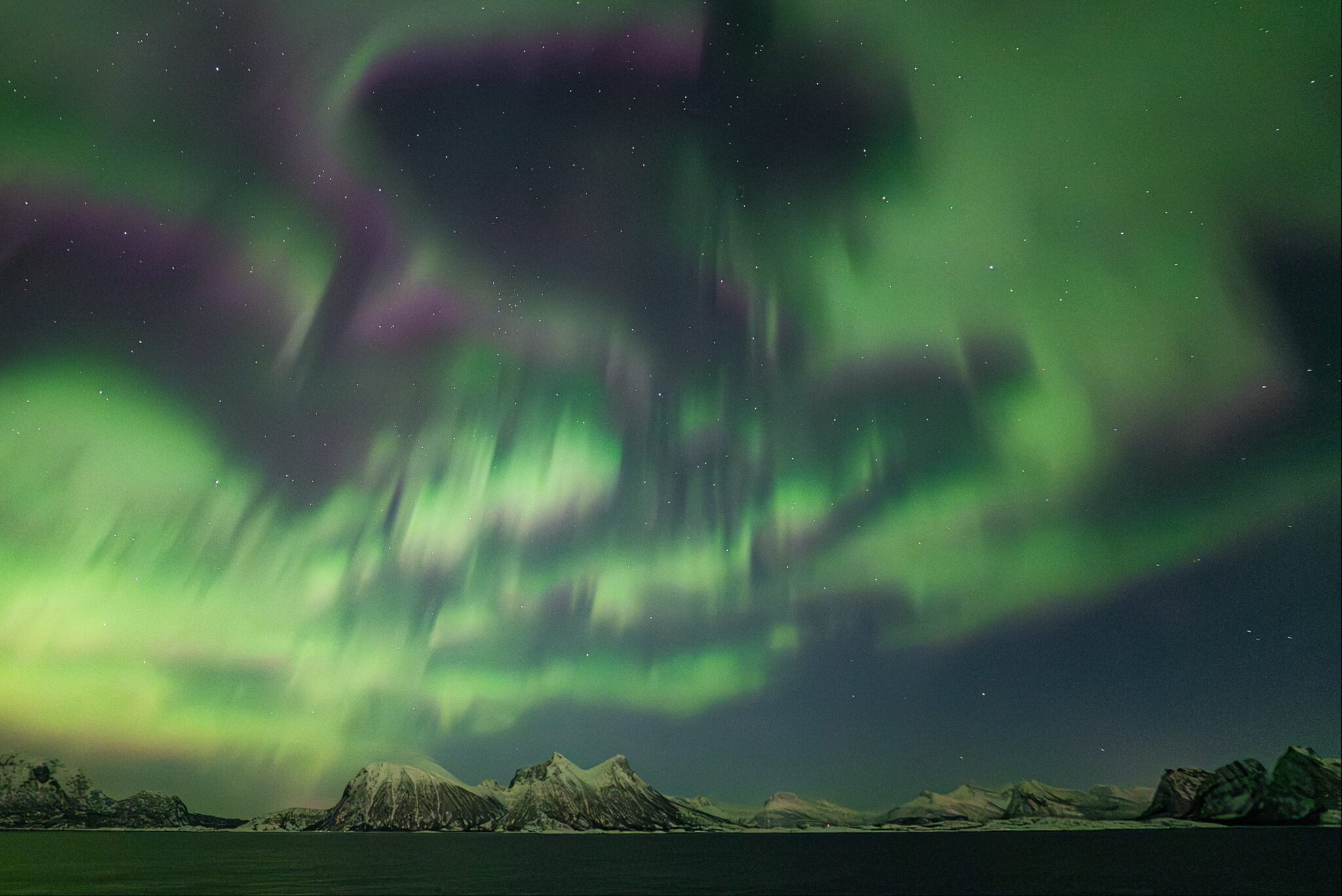
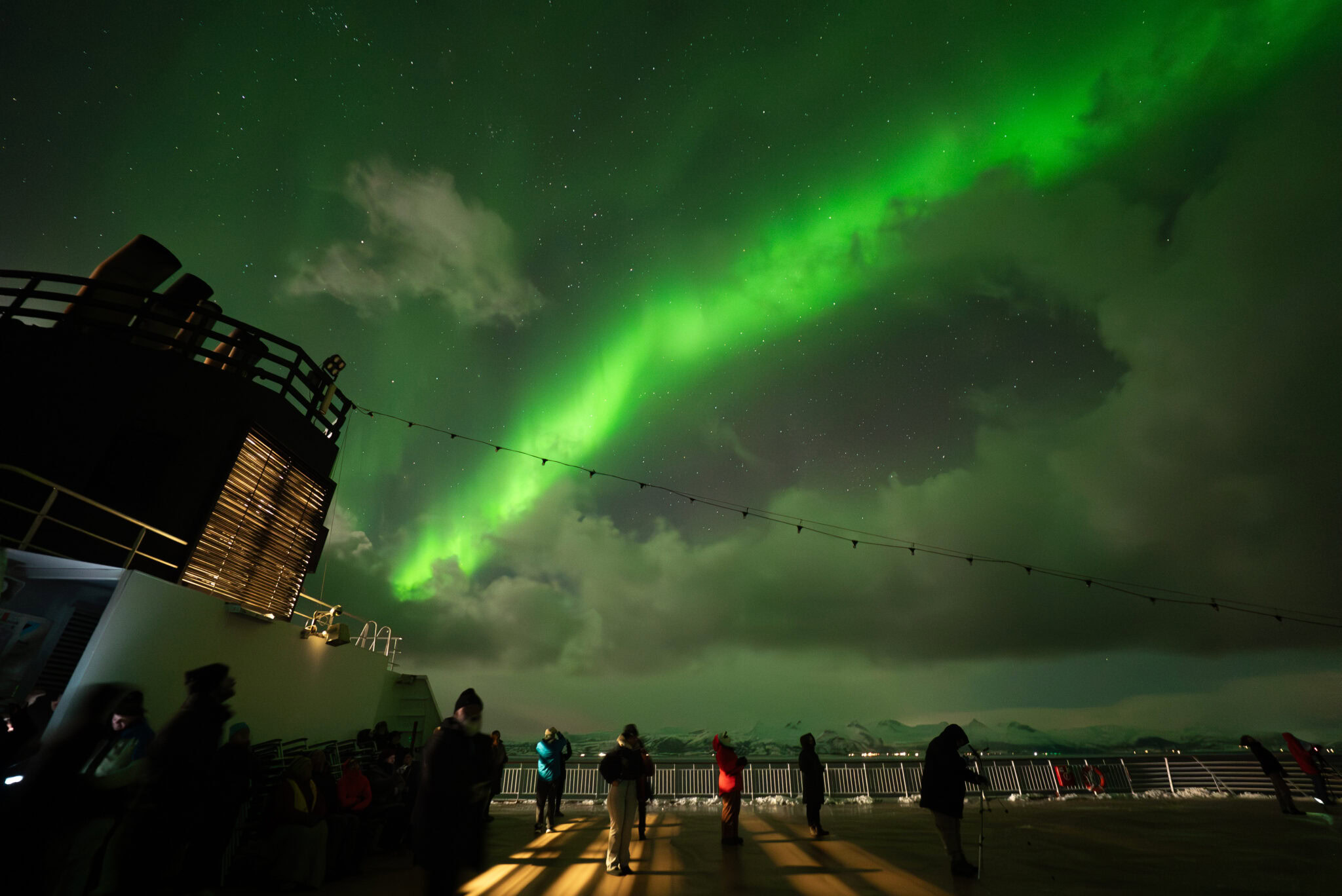
It was just after 11 p.m. when the lights began dancing in earnest. They’d been teasing us all night, a dim glow peeking from behind clouds. But now the performance had started. The clouds cleared and ribbons of bright green light waltzed across the inky sky, tumbling and shifting into new patterns, each more striking than the last. No two moments looked the same.
I could have watched for hours. But Kerss pointed out that how you watch matters almost as much as where. Dark skies are common wisdom among aurora chasers, but it turns out that skipping alcohol can also help your eyes adjust to the dark. And even glancing at a bright screen can set that adjustment back in an instant.
As the ship snaked its way along the rugged coastline, I sat down with Kerss to hear his most unconventional tips for spotting the aurora borealis, from the science of pupil dilation to a surprisingly low-tech trick involving a cyan blue square. But the conversation kept returning to time: the patience it takes to let your eyes adjust, the magnetic midnight that governs when the aurora peaks, and the billions of years these lights have been illuminating the Earth, long before anyone was counting.
Crown & Caliber: You mentioned that alcohol can affect how you see the northern lights. How does that work?
Tom Kerss: Most people are experientially aware that they see better in the dark if they wait to adapt, but there are some granular ways that you can improve your vision. The first one is staying sober because when you drink, your pupil does not dilate to the same size; the maximum pupil dilation is reduced. What that means is that the hole in your eye that actually lets in light cannot grow as large when you’re drunk as it can when you’re sober. Your rod cells come online in the dark. They don’t see in color, but they see very sensitively. By drinking, you reduce the ability for your pupil to expand, and staying sober before a northern lights session can be the difference of around two times more brightness, which is significant. That is more crucial for young people than older people because in younger people, the range that your pupil dilates is much larger. So if you’re older and you want to have a glass of wine, it’s not going to impede your aurora chasing that much.
C&C: If you’re somewhere very dark where there is a good chance of seeing the aurora, is there a best time to go out to try to spot the northern lights?
TK: It’s not about midnight, it’s not about solar time, it’s about magnetic time. So wherever you live, you should look up the magnetic local time where you are. This will differ everywhere in the world because the best time to look for the aurora will be at magnetic local midnight. That’s not necessarily at midnight on the clock, but could be 30 minutes after midnight, it could be an hour after midnight.
C&C: The aurora often shows up brighter in photos than it does to the naked eye, and it’s tempting to keep snapping away when the lights finally do come out. But does using your phone actually hurt your chances of seeing the aurora?
TK: It takes 20, 30 minutes to fully adapt to darkness, but it takes a 10th of a second to fully unadapt. Put your phone screen on its lowest brightness setting because if you even glance at your phone just to look at the time, and it’s on its surface of the sun brightness you will immediately remove all of the work you’ve put into adapting to the dark, and your odds of seeing the aurora will drastically drop and gradually climb again as you adjust.
C&C: Are there other ways to help your eyes adapt faster?
TK: In the center of each eye, where the optic nerve connects to your retina, there is a blind spot in your eye. Now, normally this isn’t an issue because during the day, when there’s light outside, you use your cone cells, and your cone cells are very densely packed in the middle of your eye so they overcome the blind spot. But at night, when your cone cells are going to sleep and they’re not helping you anymore. If you look slightly to one side of an object, it becomes visible again. Astronomers call this averted vision, and this means looking slightly away from what you actually want to see. Don’t look at the aurora, look slightly to one side, and then it will appear brighter to you.
C&C: That’s completely counterintuitive. Are there any other techniques?
TK: If you want to really improve your odds, periodically through your session, every 30 minutes or so, put a cyan blue panel on your phone on its lowest brightness and just look at it for a second or so and then put it away again. This recalibrates the sensitivity of your rod cells and effectively tells your brain to go back to maximum sensitivity after they’ve kind of started to get fatigued. The science makes sense, we know the mechanism for why it works, but the exact wavelength you need, we’re not sure.
C&C: You spend countless hours tracking and looking for the northern lights. What is it about the phenomenon that you find so captivating?
TK: Auroras have been occurring on planet Earth for billions of years, so perhaps 300,000 years ago even, the earliest Homo sapiens possibly already saw it. What they thought of it, we could only imagine, but we can still experience what they experienced. We can have just as much wonder as they had because without the technology in the way, it is just an astonishing, beautiful, compelling light show: silent beauty that has its own character and is different every single time. And it ultimately is the end point of a huge system of physical processes we can’t comprehend, made visible.
C&C: All of these celestial phenomena are so far away, measured in actual light-years. How does that affect how you think about time here on Earth?
TK: It’s impossible not to look back in time when we observe the night sky. Even the moon’s light takes more than one second to reach us on the ground. The stars we see are apparitions of where and how they appeared tens, hundreds or thousands of years ago. In the truest sense, astronomy is time travel, albeit strictly in one direction.
C&C: Does that ever make you feel small?
TK: Personally, in contemplating deep time, I find some strange comfort in my own fleeting existence. By comparison, the universe is practically eternal. It was there before me and will be long after I’m gone, and innumerable beings will be born within it. I’m content to be a small part of that eternal story.
This interview has been edited for length and clarity