Robert Duvall, who died Sunday, Feb. 15, at 95, built a storied acting career not by dominating the screen, but by mastering its tempo, channeling a particular kind of American masculinity that moved with the discipline of a second hand: restrained, confident, and quietly in command.
Raised in a Navy family by an admiral father, Duvall grew up inside institutions that measured life in ranks, rituals, and reveille, and where punctuality is not optional.
Across roles as consigliere Tom Hagen in “The Godfather,” “Parts I & II,” Lt. Col. Kilgore in “Apocalypse Now,” and Bull Meechum in “The Great Santini,” the former Army veteran turned stage-trained actor gained presence through restraint. He played men who valued structure: who scheduled violence, who respected order, who believed in moral geometry. As Hagen, he offered administrative legitimacy to the Corleone mafia family. As Kilgore, he embodied the calculated precision of a U.S. military operation. As Meechum, he exemplified the rigid, ritualized command structure of a career Marine aviator, inspired in part by his own upbringing.
Both on location and in character, the Robert Duvall of “Apocalypse Now” was a steadying presence. Writer and director Fax Bahr recalls interviewing Duvall for his 1991 Emmy-award winning documentary “Hearts of Darkness: A Filmmaker’s Apocalypse” chronicling the infamously chaotic conditions of Coppola’s masterpiece.
“He seemed to be meticulously prepared, both for the interview and for his character,” Bahr says. “He did quite a bit of research with Vietnam War veterans and pilots in the Air Cavalry, and utilized that in building his character.” In a production defined by typhoons, improvisation, and fraying nerves, Duvall projected authority without theatrics.
A critic of method acting, Duvall characterized his technique simply: “You talk, you listen,” emphasizing direct engagement over performative excess. He understood the rhythm of a scene.
Duvall often stood out by blending in. In movies known for operatic showcases by the likes of Marlon Brando, Martin Sheen, and Al Pacino, Duvall is almost unnervingly composed, and armored in subtle detail. In “Apocalypse Now,” he’s dressed in official jungle fatigues and a Stetson hat as he surfs the coast and levels it with napalm. BAMF Style report on the specificity of Duvall’s uniform, identifying his jacket as a transitional OG-107 decorated with standard-issue insignia and badging, but also several personal effects: a gold-and-ruby class ring, the Cavalryman’s hat and scarf, and a steel watch on a dark-leather strap.
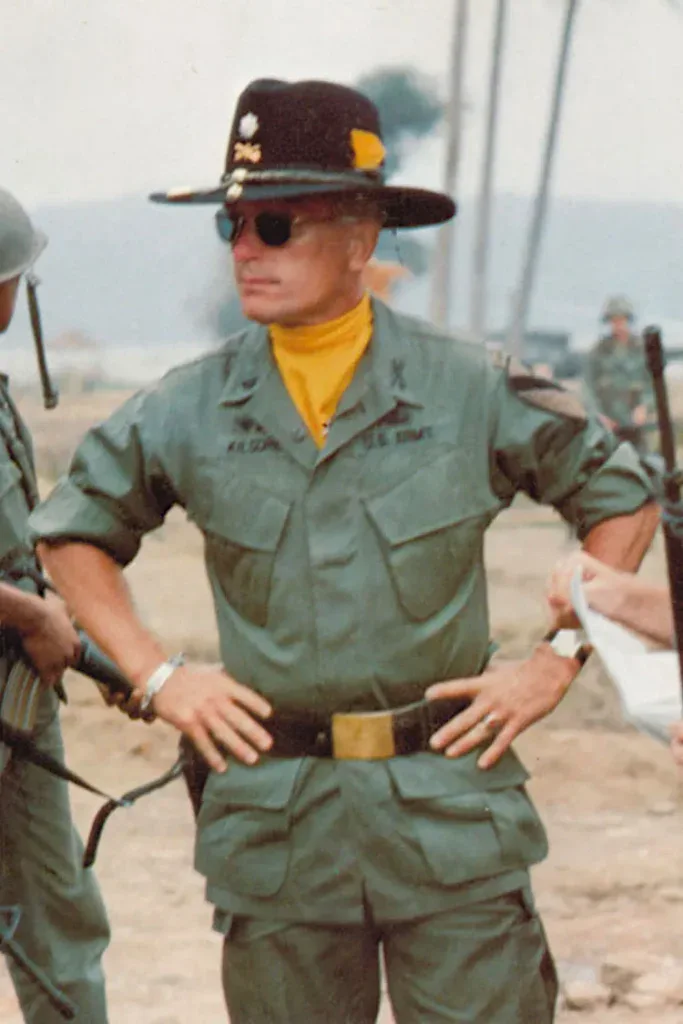
That watch, glimpsed, never centered, may be the secret to Kilgore’s character. Duvall’s watch in “Apocalypse Now” has never been definitively identified, though some speculate it to be a Hamilton or Mil-Spec Benrus like those given to the US military. Its anonymity alongside several famous watches has made it an object of enduring fascination. Cinema remembers Brando’s bezelless Rolex as a precision instrument gone feral and Sheen’s Seiko “Captain Willard” Turtle as survivalist grit.
Duvall’s wardrobe in “The Godfather” embodies a similar sense of unornamented gravitas. Among the gold watches and silk bravado of the Corleone family, Hagen’s wrist is discreet: often bare, occasionally visible with a square, black-dialed piece. His power lies in understanding procedure, not in peacocking. He is the man who knows when the meeting starts and when it ends.
In “Days of Thunder,” where he plays veteran NASCAR crew chief Harry Hogge, his gold dress watch, sometimes identified as a vintage Girard-Perregaux, though again never confirmed, reads as old-school professional polish. On the track, milliseconds determine decisions. In a sport increasingly defined by sponsorship excess and spectacle, Hogge’s quiet timepiece signals the elder’s respect.
Duvall’s style helped define a genre of masculinity rooted in seriousness not swagger. He favored watches the way he favored dialogue: functional, unshowy, built to endure. A disciple of the Neighborhood Playhouse and the Actor’s Studio, his studiousness culminated in his Academy Award–winning performance in “Tender Mercies.” Dressed in flannel, denim, and a cowboy hat embellished only by a patinated gold watch, he played the fallen country singer Mac Sledge with bare humility. The watch reads as a token of time lost and time, perhaps, redeemed.
“Duvall totally inhabited his costumes,” recalls costume designer Ruth Myers, who dressed the actor in “Deep Impact.” “It was really important to create an accurate and stripped-down look to emphasize the danger of the situation,” which meant Duvall would wear a polo shirt with a nondescript three-register chronograph, likely an Omega Speedmaster. “We were helped enormously by the fact that he had the bearing and authority to wear what was a very simple, uniformed look with complete conviction.”
Even in a film about extinction, his watch choice suggested measurement over melodrama, dutifully counting the seconds.
Duvall’s powerful charisma was warmed by generosity for those who had the opportunity to work with him. “He really thought about his character and what his experience had been like on the set,” says Bahr. “He couldn’t have been more gracious and forthcoming.”
“At the time of filming, I had a small, very loved, but badly behaved rescue dog,” Myers remembers. “I was nervous to meet him, as I was in awe of his talent. When I got to the fitting room he was lying on the floor cuddling my rapturous dog.” Duvall’s formidable screen presence had dissolved into something gentle. “He was an actor who made communication and cooperation easy by virtue of his intelligence, talent, and commitment.”
Duvall is remembered as a man unhurried, giving his time freely. For an actor so associated with authority, his legacy may rest in something quieter: the ability to control a scene by pacing it.