I’m not sure when I got so old, but these days my idea of a good time is sitting in someone’s backyard, smoking good cigars, and drinking fancy whiskey with a couple of other quinquagenarians, talking about the good old days. Going out? Dealing with parking? And loud music and the damn kids who like the loud music? Pass. No, these days a memorable Saturday night involves a couple fresh cracks (whiskey slang for new bottles) and being in bed before midnight. My time has passed, it’s cool. But speaking of time, what about a whiskey watch?
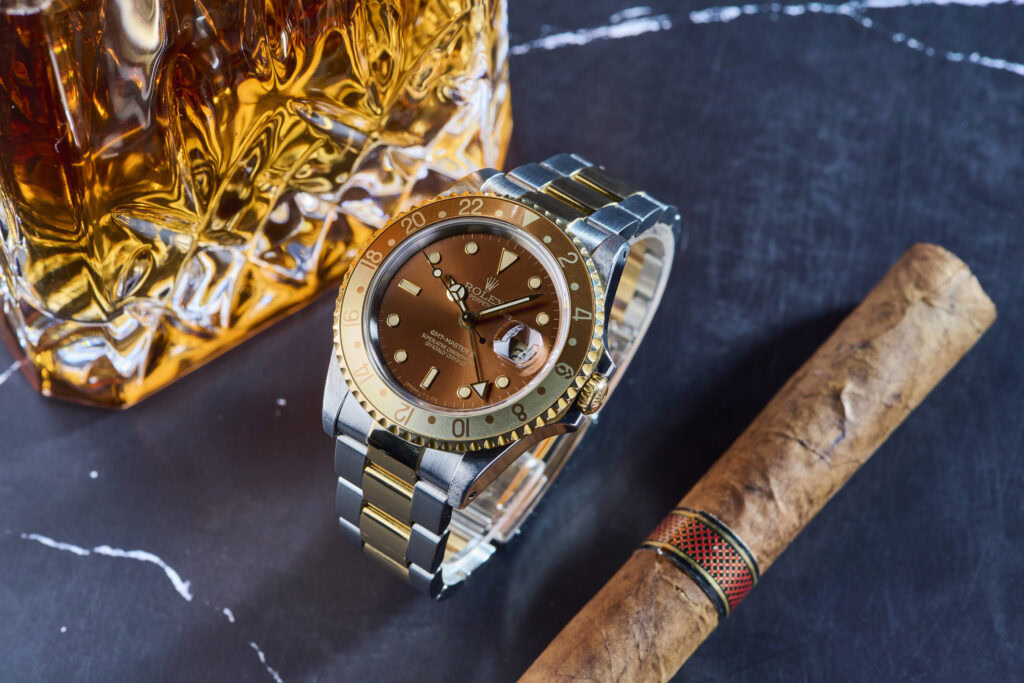
We’ve got watches for everything else. Travel watches, diving watches, pilots watches, for drivers, for engineers, for scientists, dress watches, field watches, watches for hunting, for yachting, for rescue teams, watches that double as jewelry, and more I’m forgetting. Why not a watch you wear when you’re sipping on a great bourbon? Especially when your buddies are too old to come over and sit in the backyard with you. What would such a watch look like? What would it do? I have some ideas.
There’s a whiskey bottler in the UK called The Scotch Malt Whisky Society (in the States we spell it “whiskey;” in Scotland it’s “whisky.”). SMWS runs around Scotland (among other places, like Kentucky) and buys up barrels from essentially every distillery. Then, when they feel the juice is ripe, they bottle it under their own label. There are plenty of other bottlers that do the same thing, but I mention The Scotch Malt Whisky Society because of the little poems they pass off as labels. For example, cask 80.52 (where 80 represents the distillery and 52 means it’s the 52nd barrel from said distillery) is called, “A Topic of Conversation,” and the description reads, “The divided opinion between yum yum cake and strawberry tarts or chemicals and Manchego cheese. Water certainly smooths out the differences.”
Admittedly, that’s too much to engrave onto a case back. The point, however, is that the above seems cute when one is stone sober. After a strong glass or two, you’re into the argument. More like strawberry jam, dude. Which chemicals? And I’m getting cheese but not necessarily Manchego. Could that be Emmentaler? It’s fun whiskey, trust me, but back to watches. The above would have to be expressed mechanically then rendered physically.
Not every whiskey watch has to go that deep, but a piece of whimsy, a certain something special to contemplate. This could be accomplished via a complication – who amongst us hasn’t fiddled with a chronometer while buzzed? It could be an engraving, an artsy dial, an inlay, to go all Office Space, a piece of flair – anything that would set the watch apart from a garden variety tool watch and elevate the piece to the realm of the fanciful.
Back to complications, I’ve long been fascinated by the concept of traditional Japanese time. Not that I fully understand it, but before Japan was westernized, hours had different lengths. Instead of 24 equal subdivisions, hours in the morning and the evening were shorter, whereas during the day they contained more minutes. There are a few boutique watchmakers in Japan who still build watches using traditional Japanese time where the hours are divided into six periods of day and night, called ittoki. Here’s the kicker—the ittoki varied by season! Winter daytime hours were shorter than summer daytime hours. Wild stuff, for sure. Definitely something worth contemplating while enjoying a good bourbon or two. Forget about quartz movements; what’s the point of a mechanical timepiece in the age of the smartphone? One explanation is an object that gets one thinking about time itself.
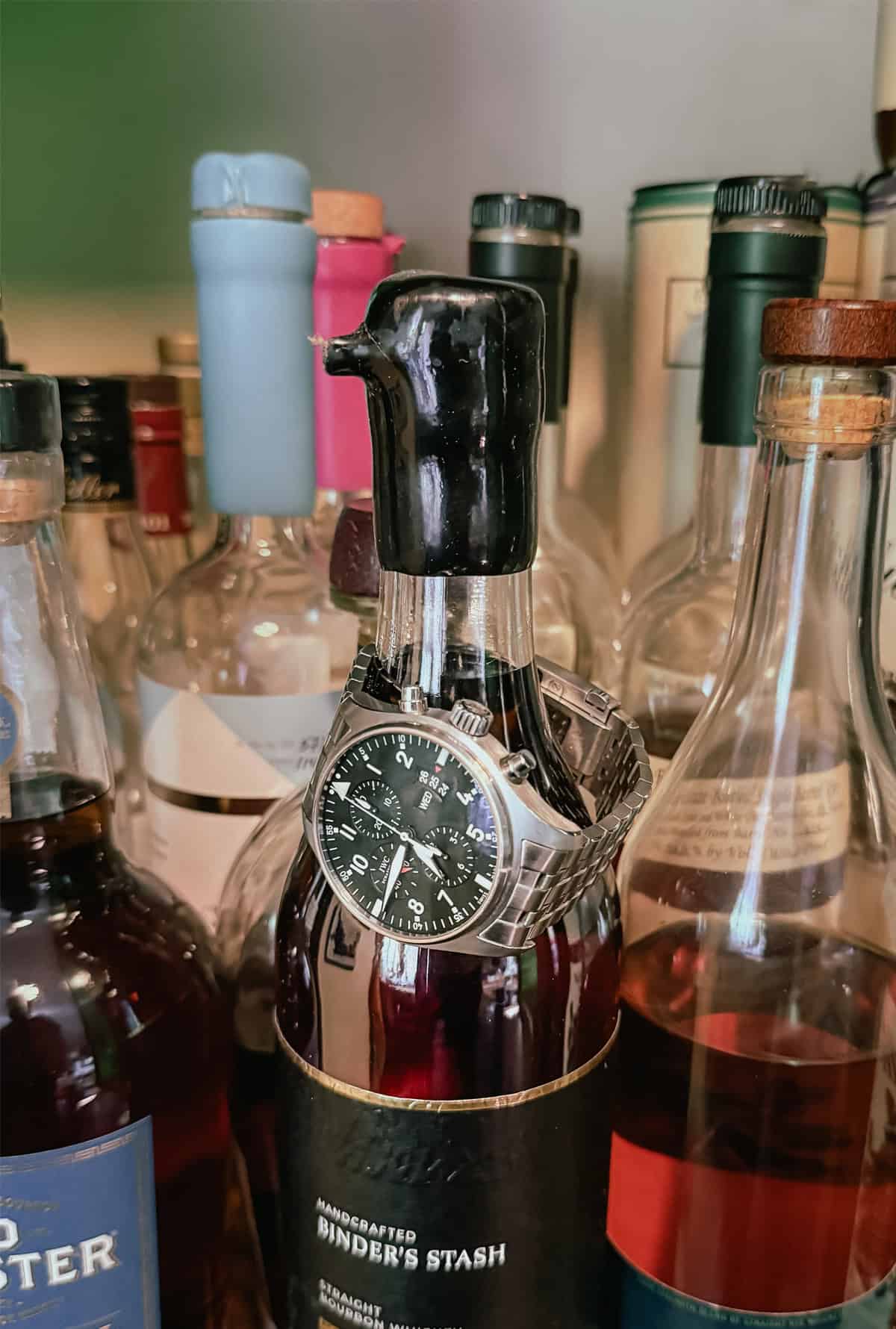
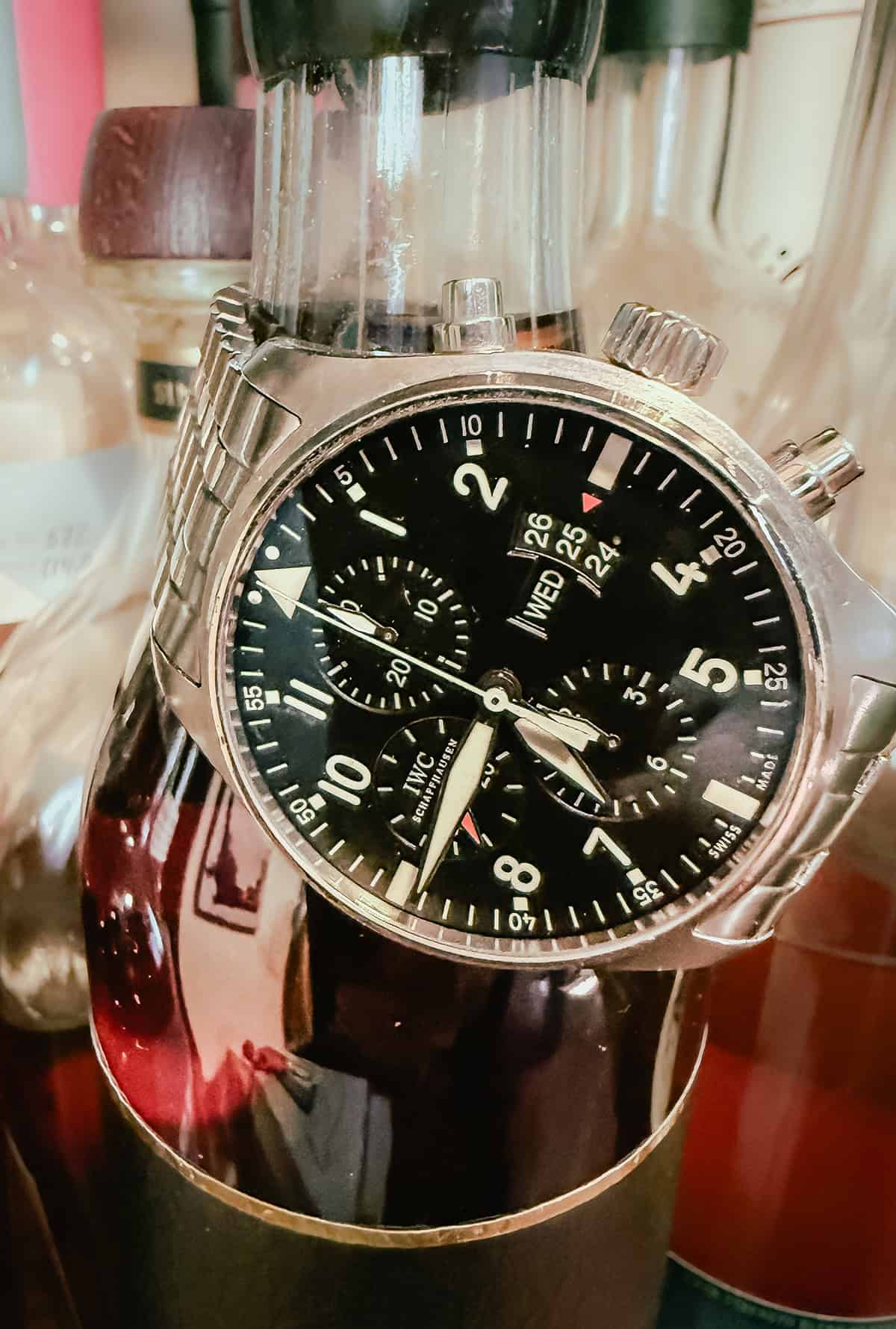
Though imagining the mechanical hoops a horologist would have to jump through to produce such a watch (multiple string bars, six faces, etc.) might be a bridge too far. I should also mention that each hour was assigned a Japanese astrological sign. Hour of the goat, for example. A far simpler complication is an open date wheel. I have an IWC Pilot Chronograph that happens to have one. If you’re not familiar, an open date wheel not only displays the current date, but also shows both the previous and upcoming date. Stylistically it’s meant to resemble an aircraft instrument. But stare at it long enough, and it becomes a mental diary, an unwritten journal. Call it a daily reflection. What did I accomplish yesterday? Where am I right now? What’s on the docket for tomorrow? The past, the present, the future, right there on your wrist. Again, just a bit of whimsy, but whimsy that would only be enhanced with a nice tumbler of booze.
Does the world need a whiskey watch? I’d posit that a whiskey watch would be much more useful to most people than the abovementioned pilot’s watch. Think about how infrequently dive watches go deeper than a few feet of water. Be honest here: how many of you GMT owners set the second hour hand when you travel? That’s what I thought. But a whiskey watch? A timepiece that offers a genuine alternative to doom scrolling your way through a night of single malts? Sort of sells itself, no?
To summarize, a whiskey watch would offer a certain something, a je ne sais quoi to occupy the mind as it enters a (hopefully) relaxed and altered state. Any of what I’ve mentioned would work—as would just staring deep and hard at whatever happens to be on your wrist at that moment—but I wonder if such a class of watches would encourage new complications. New complexities that might just pair perfectly with fermented and distilled grains. It’s certainly something worth pondering, eh?
And if you’re a watchmaker out there that thinks this whiskey watch idea might be going places, hit me up. I got some thoughts that I haven’t yet shared!